From Promenade to Pocket Park: How the Urban Walk Became Leisure
Urban walk history shows how promenades and pocket parks offer different settings for leisure on foot, helping you choose a city stroll that fits your mood.
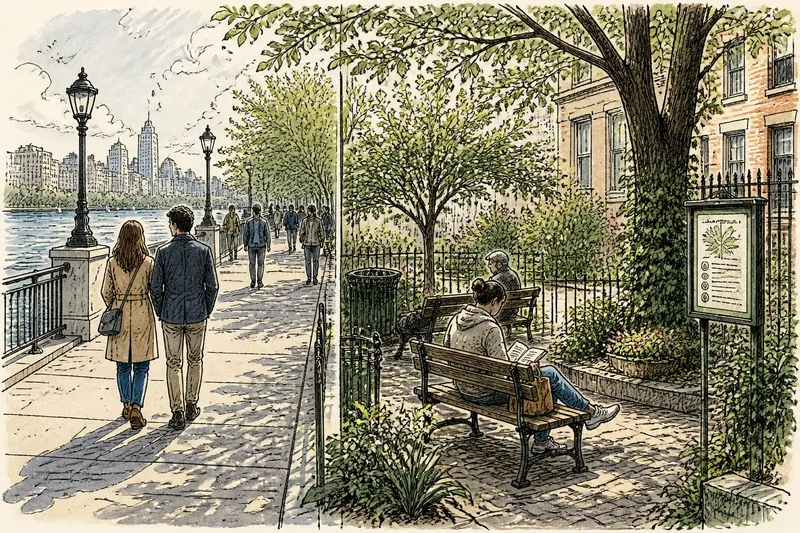
Urban walk history is visible in the difference between strolling along a waterfront path and ducking into a small neighbourhood green. Both let you spend time outside without needing to reach a particular destination, but their settings invite different kinds of leisure.
There was no single route by which cities made walking a pastime. Street layouts, local rules and public access varied from place to place. Promenades and pocket parks are useful examples of how some urban spaces came to accommodate walking for pleasure, without standing for every city’s experience.
What makes a promenade different from an ordinary street?
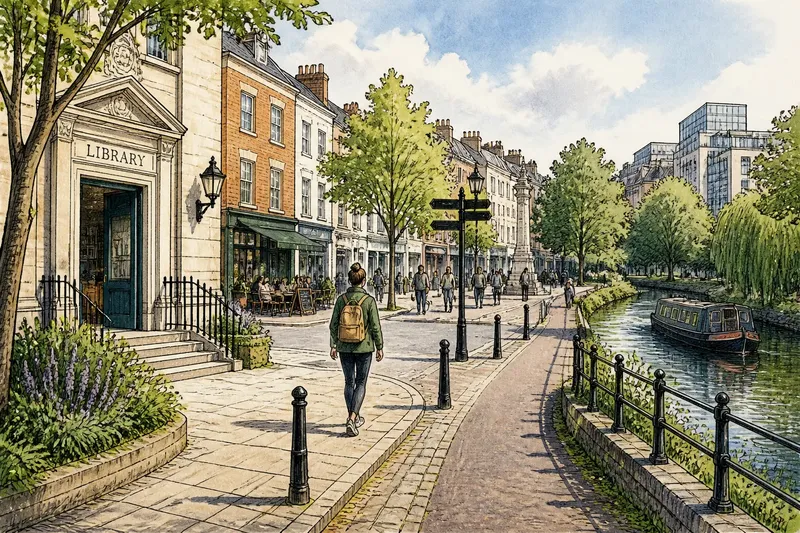
A promenade is a route associated with strolling and taking in the surroundings, rather than simply getting from one useful destination to another. It might follow a waterfront, pass through a planted avenue or open onto a public square. The route itself becomes part of the outing.
Ordinary streets also support wandering, but their design and daily use may centre on movement between homes, shops and other destinations. In some places, promenades and landscaped public grounds offered a more deliberate setting for pausing and walking at an unhurried pace. The details depended on who managed the space and how it was used.
Access was not necessarily equal or unrestricted. Local customs, opening hours, conduct rules and other conditions could shape who felt welcome and what visitors were permitted to do. A place intended for leisure could still have boundaries.
Why did strolling become a public pastime?
Walking slowly in public can be a social activity without requiring a shared meal, a ticket or a formal plan. On a promenade, people might walk together, exchange greetings or stop to look at a view. The surroundings give a casual outing a sense of occasion.
Strolling also asks little preparation: you can choose your own pace, pause when something catches your eye and turn back when you have had enough. As public parks developed in different local contexts, some offered another setting for leisure on foot, with paths, trees and places to sit.
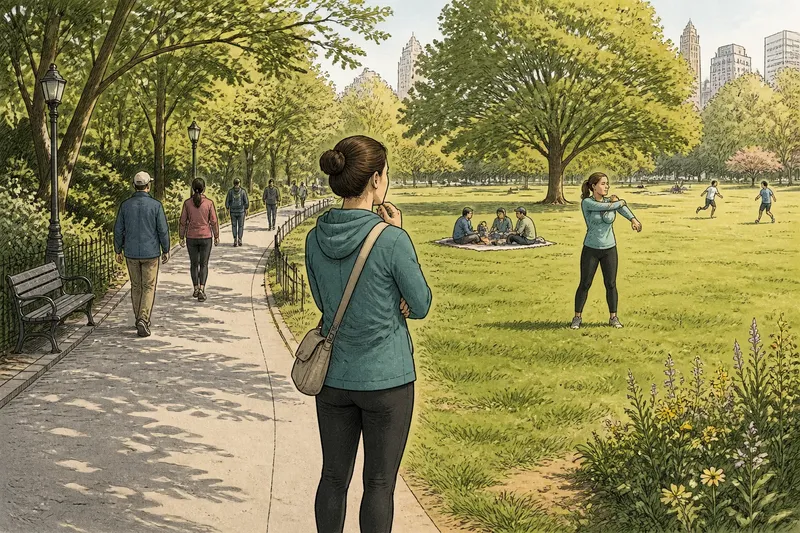
A park walk need not be a social performance. It can mean watching children play, taking a quiet circuit or sitting alone for a while. The purpose depends on the visitor, not only on the design of the space.
How does a pocket park change the scale of a walk?
A pocket park is a small green space within a built-up area. It may sit on a street corner or between buildings, making a pause outdoors easier to fit around a nearby errand. It is not a miniature version of every larger park: a compact space may offer a place to sit without providing a long route.
That closeness gives it a different role from a promenade. A promenade often makes the walk itself the outing; a pocket park can be a brief stop along the way. Someone might pick up groceries, pause beneath a tree, then continue home.
Small parks have limits. A compact green may feel busy when its benches are occupied, and it may not suit someone hoping to keep walking for a long time. Its value lies in offering a nearby place to pause, rather than replacing a larger park or a scenic route.
How can you choose an urban walk that suits you?
Start with what you want from the outing, then match the place to that intention. A promenade, a larger park and a pocket park each offer a different setting.
- If you want to watch city life, notice whether a promenade, waterfront path or civic square has an open route and activity you would enjoy. If it does, choose it for a slow walk; if the crowds or noise would distract you, try a quieter park path instead.
- If you want to keep walking, check whether a larger park has connected paths and an exit that suits your plans. If it does, use it for an unhurried circuit; if the route is limited or access is unclear, choose a familiar street route or another park.
- If you have a short gap between errands, check whether a pocket park is close to your existing route and open for casual visits. If it is, pause there; if it is closed or out of the way, keep your walk on nearby public streets.
- If you want company without arranging an activity, look for a path where people can walk side by side at a comfortable pace. If the route allows that, invite someone along; if it feels too narrow or busy, choose a broader path or meet at a quieter spot.
- If you want quiet, check whether the site has a less central path, a place to sit or a time that suits a calm visit. If it does, head there; if the space is busy, try a smaller green or a less crowded route nearby.
- If you want to linger, read entrance signs and posted information about hours and permitted activities. If the visit you have in mind fits the rules, settle in; if it does not, choose another public place with suitable access.
Say you have just bought a loaf at a neighbourhood bakery and have a free stretch before going home. In this invented situation, you check the posted notice at a pocket park two streets away and see that it is open; you decide to walk there, sit briefly and return by a different street. The result is a short outing with a place to pause. If the notice instead showed that the park was closed, the sensible alternative would be a nearby public street route rather than a detour to a distant promenade.
It is not worth trying to turn every stroll into a tour of architectural history or a hunt for the city’s “best” green space. A nearby place that fits your mood is often more useful than crossing town for an idealised setting.
What should you know about promenades and pocket parks?
Is a promenade meant for walking or looking?
It can be both. A promenade gives you a route for a slow walk, while its views, planting or passing activity offer things to notice along the way.
Can a pocket park be a walking destination?
Yes, even if it has no long path. Walking there, moving around its edges or pausing on a bench can make it part of a local stroll.
What is the difference between a public garden and a promenade?
A public garden centres on planted space and places to pause, while a promenade centres on a route for strolling. A park may include paths that feel promenade-like, and a promenade may pass through planted ground.
How can you tell whether a public space welcomes casual visits?
Check entrance signs and posted opening information, then see whether the paths and seating suit the visit you have in mind. Local rules and notices set the conditions for access and activities.
What can urban walk history offer a walker now?
Urban walk history offers a useful way to think about the spaces around you: a promenade can make the route an occasion, while a pocket park brings a small pause close to daily life. These examples do not describe every city’s past, but they help explain why different public places can make room for leisure on foot.
Before setting out, ask whether you want a view, company, greenery or simply a bench near your usual route. That small choice can turn a walk from a journey between errands into time spent in a public place, while keeping the outing suited to the space and its local rules.