Park Path or Open Lawn: Two Kinds of Moving Space
Park path or open lawn? See how a clear route or a broad patch of grass can shape an unhurried walk, stretch or pause in the city.
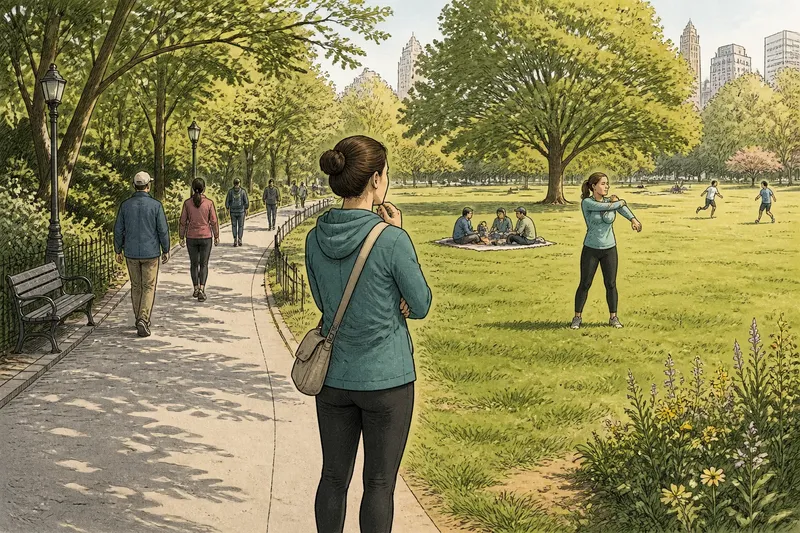
A park path gives an unhurried walk a direction; an open lawn gives it room to wander. If you are choosing between a park path or open lawn for easy movement, notice whether you want the next few minutes to feel guided or open-ended. Neither setting is automatically better: each changes how you place your attention and where your movement can go.
What does a path ask of your attention?
A path quietly answers the question, “Where next?” Its edge, curve or paving joints offer a line to follow, so you can walk without repeatedly choosing a direction. That can feel pleasant when your mind is busy or you simply want to keep moving without turning the outing into a plan.
Look at the surface as well as the route. A broad, smooth path may suit a relaxed stroll, while gravel, tree roots or uneven paving invite a slower pace and a little more attention to your footing. If people are passing in both directions, keep to a predictable side where local custom makes that clear, and leave space for anyone moving faster.
Paths also bring small destinations into view: a bench, a fountain, a gate or a stand of trees. Let one of these catch your eye without making it a target you must reach. The pleasure is in having a gentle line through the park, not in turning every landmark into a checkpoint.
What does an open lawn make possible?
A lawn offers no built-in route, which can make even modest movement feel more self-directed. You might cross a short stretch, pause near a tree, then change direction because the light or the view looks inviting. The space is less about following a line and more about deciding how much room you want around you.
That freedom works well for loose, unhurried movement: an easy stroll across the grass, a standing stretch, or a few minutes of gentle mobility if the ground is suitable. A lawn can also make it easier to stop without feeling that you are blocking anyone’s way. Choose a spot where you can see other park users and give picnickers, games and wildlife plenty of room.
Grass is not always the softer or simpler choice. It may be damp, muddy, sloping or marked by hidden hollows, and some lawns are closed to foot traffic to protect the ground. A dry, even patch can feel inviting; a wet or worn one may make the path the more comfortable option.
Which space suits the movement you have in mind?
Think about the quality of movement you want rather than its intensity. A path lends itself to steady walking and a clear forward gaze. A lawn suits movement with pauses, changes of direction or a wider stance, provided the surface and park rules make that comfortable.
- Choose the path when you want a clear direction, a firm surface or an easy way to keep moving.
- Choose the lawn when you want room to pause, turn or move without following a fixed line.
- Stay near the edge if a busy lawn feels exposed; you can use its open space without standing in the middle.
- Switch spaces if your preferred surface is crowded, wet or being used for another activity.
Say you arrive at a city park after sitting indoors and want a calm few minutes on your feet. The main path is busy, but a dry strip of lawn beside a line of trees is open; you could walk there at an easy pace, pause for a shoulder stretch, then return to the path when it thins out. The observable difference is simple: the lawn gives you room to pause, while the path makes the return direction obvious.
For any stretch or balance movement, keep it within a comfortable range and choose ground that feels stable underfoot. Follow posted park rules and any relevant instructions about access or lawn use; where a decision depends on local rules or site guidance, those instructions take precedence.
How can you read the space before settling in?
Take a moment to notice what the park is already asking of its visitors. A path may be a commuting line for cyclists and walkers, while a lawn may be hosting a class, a family gathering or a game. The best place for a quiet movement break is often the bit that lets others carry on without having to weave around you.
Check the ground, shade and sightlines. A tree can make a lawn edge comfortable on a warm day, but low branches or roots may interrupt movement. On a path, a shaded stretch can be pleasant, though a narrow section may leave little room to pause. A bench nearby offers a simple fallback if standing or walking becomes uncomfortable.
It is not worth scouting every corner for a perfectly empty patch. A quick glance for wet ground, active play and the flow of foot traffic is enough for an ordinary, gentle visit. If the space feels awkward, change position or choose the other surface rather than forcing a routine into a poor fit.
What should you know about a park path or open lawn?
Is a path better for a relaxed walk?
A path can make a relaxed walk feel straightforward because it provides a visible direction and usually a more defined surface. Its comfort still depends on width, crowding and paving, so choose a stretch that allows you to move at ease.
Can I stretch on an open lawn?
An open lawn can offer room for gentle stretching, provided the ground is even enough for the movement and the area is open to visitors. Keep your range comfortable and leave space around other people.
What if the lawn is wet or uneven?
Use a dry section of path or another suitable spot rather than risking a slip or an awkward step. If neither surface feels comfortable, a pause on a bench is a sensible choice.
Can I combine both spaces in one visit?
Yes: a path can provide a clear approach, and a nearby lawn can offer room to pause before you head back. Let the conditions and other park users guide where you stop.
How do you choose without overthinking it?
For a park path or open lawn, make the choice by asking one small question: do you want direction, or do you want room? Follow the path if a steady line sounds welcome; step onto a suitable lawn if you would rather pause or change direction freely. If the first choice does not feel right once you are there, move to the other space.
That simple distinction can make a familiar park feel more responsive. A path carries your attention forward; a lawn gives it somewhere to settle. On a day when neither seems inviting, a bench, a shaded edge or a short pause can still be part of moving well through the park.