The Gentle Logic of a Loop Walk
A loop walk gives a short city walk a clear start and return point, making it easier to picture, fit between errands and finish without retracing your route.
A loop walk makes a short city walk easier to picture: leave from a familiar point, follow a route that bends through the neighbourhood, and return to where you began. That simple shape can help a walk fit between errands or work without turning it into a route-planning project.
The useful part is not the geometry. It is knowing, before you set off, roughly where the walk goes and how it ends. A café, library entrance or corner shop can serve as the anchor, while quieter side streets and a public path do the connecting.
Why does a loop feel easier to fit into the day?
A route that returns to its starting point answers a small but persistent question: how will I get back? You do not need to arrange a lift, catch a bus from a different stop or retrace every block. For a walk squeezed between two commitments, that removes a decision at the far end.
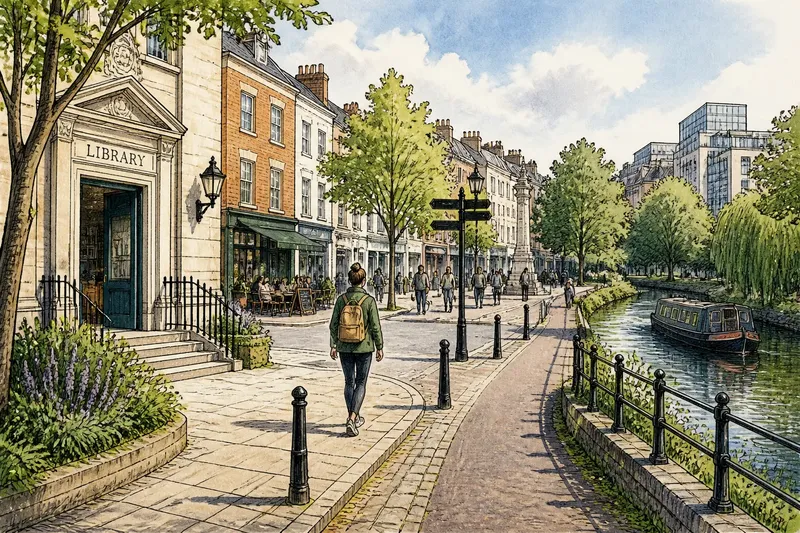
The route is also easier to hold in mind. “Past the bakery, through the square, then back along the canal path” is a sequence of recognisable places, not a string of turns to memorise. If your attention shifts to a phone call or a shop window, you can pick up the route again at the next landmark.
A loop can suit a short break because its finish point is already built in. You can glance at the time before leaving and choose a compact circuit, rather than beginning in one direction and hoping the return journey works out.
How do you choose a useful city loop?
Start with a place you already pass: your front door, a workplace entrance or the stop where you get off the bus. Then look for a few clear landmarks and streets that bring you back without forcing you to cross a road you would rather avoid.
Think about the feel of the route as well as its shape. A loop can use a busy shopping street on the way out and a residential lane on the return, offering a change of scene without making the route hard to follow. A riverside path or small public garden can make a useful middle section if its entrances and exits are easy to identify.
Say you have a break between a morning appointment and lunch near a library. You might leave by the main entrance, walk along a familiar high street, turn through a small square, follow a quieter parallel street and return to the library from the other side. The expected observable result is a walk with recognisable turning points and the library still close at the finish, rather than an open-ended outward wander.
Do not make the loop clever for its own sake. A route that doubles back through a confusing passage or circles a block merely to look symmetrical adds little. It is not worth the effort to perfect the shape on a map when an easy-to-follow route will do.
What should you check before setting off?
A quick glance at a map can reveal whether a path really connects, but the route should make sense on the ground too. Check for obvious access points and choose streets with pavements where you can walk comfortably. If a route depends on a park gate or a path through a shared site, check its opening arrangements before relying on it.
Keep the plan flexible. Roadworks, a crowded pavement or a delivery blocking a narrow street may make the neatest line inconvenient. Pick one simple alternative, such as using the next parallel street, and treat it as part of the route rather than a failure to follow the plan.
In unfamiliar neighbourhoods, make the starting point and return point easy to recognise. A distinctive station entrance is more useful than a vague instruction to meet near the junction. If you are walking with someone else, agree on that anchor so you both know where the circuit begins and ends.
How can a loop change without becoming confusing?
Once a basic circuit feels familiar, change one section at a time. You might take a different street between the square and the canal, or pass through a small market on a day when it is open. Keeping the same start and finish preserves the route’s overall shape while giving the walk a fresh middle.
That small variation can also reflect the purpose of the day. A direct loop may suit a tight break; a route through a public garden may feel calmer when you have more room in your schedule. You do not need to assign a precise duration or distance in advance. Notice how much time you have, then choose a route whose landmarks and return feel manageable.
If a section repeatedly feels awkward, remove it. A narrow pavement, an awkward crossing or a confusing junction can make a route less inviting even if it looks tidy on a map. The best loop is the one whose landmarks are clear enough that you can walk without continually checking directions.
Which loop-walk questions come up most often?
Does a loop walk need to be circular?
No. A loop can be uneven or roughly rectangular, as long as the route returns to its starting area. Familiar landmarks matter more than a perfect shape.
Can I start a loop near a bus stop?
Yes, if the stop is easy to find again and the route brings you back without a complicated transfer. A nearby shopfront or station entrance can make the return point more obvious.
What if I want to stop halfway?
Choose a route with a bench, café or sheltered public space along the way, so a pause does not leave you unsure how to get back. You can shorten the circuit by returning along a familiar street.
Should I use the same loop every day?
You can, especially if its landmarks make it easy to begin without much thought. If it starts to feel monotonous, keep the same anchor and swap one connecting street or public-space section.
What makes the return point reassuring?
The return point gives a city walk a quiet boundary: you know where you will finish, but you are not locked into one exact line. That is the gentle logic of a loop walk. Start from a familiar anchor, choose a few places you can recognise, and make the way back as clear as the way out.
For a first attempt, keep the route ordinary. A library, a square and a nearby residential street may be all you need. Once the shape is easy to recall, the walk can slip into the day as a small, self-contained trip rather than another plan to manage.